Platform
Re – Engineering
Long-term scalability requires platforms that can evolve beyond legacy constraints without limiting performance or innovation.
Service Overview
We re-engineer existing platforms into modern, cloud-ready, API-first systems that support faster development cycles, improved reliability, and easier long-term maintenance. Our work focuses on carefully modernizing core systems without disrupting day-to-day operations. By introducing modular architectures and modern engineering practices, we help organizations unlock agility while preserving the stability of their critical platforms.
Our Approach
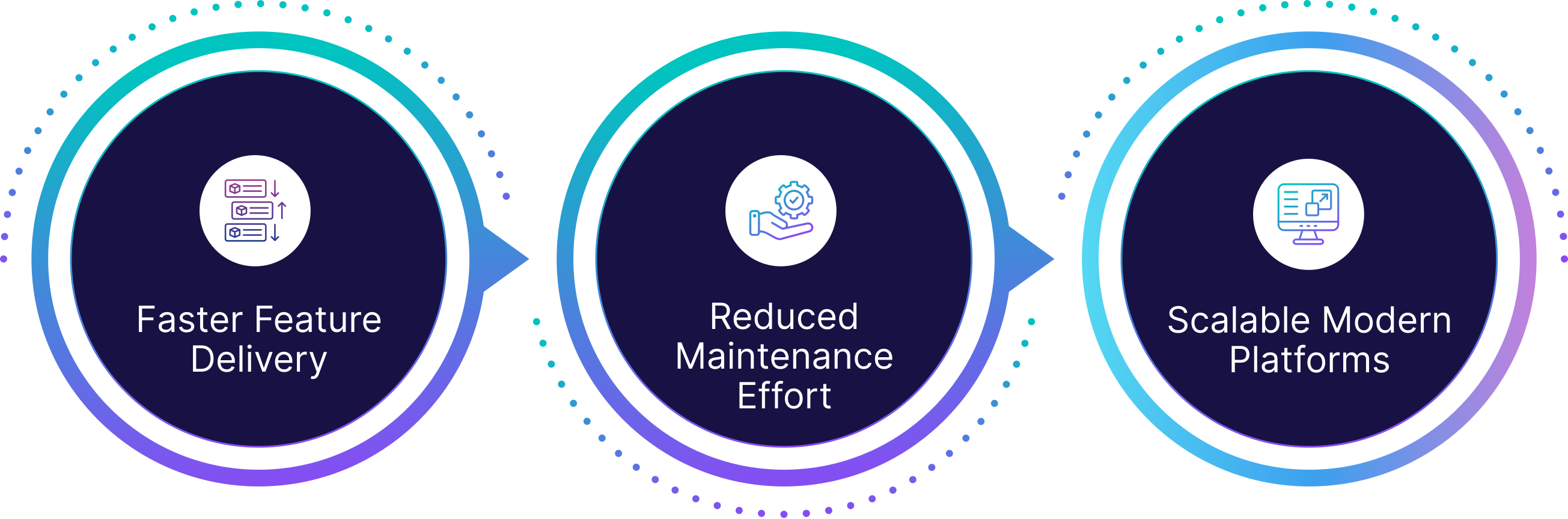
We follow a structured, risk-aware approach to platform re-engineering that balances modernization with operational stability and long-term value creation.
Our Capabilities
Legacy Platform Assessment and Re-Architecture
We begin by thoroughly assessing existing platforms to understand architectural constraints, technical debt, performance bottlenecks, and operational risks. Based on this assessment, we define a re-architecture strategy that improves system structure and scalability while minimizing unnecessary rewrites or disruption.
Monolith-to-Modular or Microservices Transitions
We help transform tightly coupled monolithic systems into modular or microservices-based architectures. This enables independent development, better fault isolation, and faster release cycles, while ensuring that business-critical functionality continues to operate reliably throughout the transition.
Cloud-Ready Platform Redesign
We redesign platforms to be cloud-ready, enabling elastic scalability, improved resilience, and simplified infrastructure management. Cloud-ready designs allow platforms to adapt to changing workloads and future business demands without extensive rework.
Security, Performance, and Scalability Upgrades
As part of re-engineering, we strengthen platform security, improve performance, and enhance scalability. This includes addressing vulnerabilities, optimizing resource usage, and ensuring the system can handle increased traffic, data volumes, and user activity.
Ongoing Platform Optimization
Modernization does not end at deployment. We continuously optimize platform performance, architecture, and operational efficiency to ensure systems remain reliable, cost-effective, and aligned with evolving usage patterns.
Our Capabilities
Legacy Platform Assessment and Re-Architecture
We begin by thoroughly assessing existing platforms to understand architectural constraints, technical debt, performance bottlenecks, and operational risks. Based on this assessment, we define a re-architecture strategy that improves system structure and scalability while minimizing unnecessary rewrites or disruption.
Monolith-to-Modular or Microservices Transitions
We help transform tightly coupled monolithic systems into modular or microservices-based architectures. This enables independent development, better fault isolation, and faster release cycles, while ensuring that business-critical functionality continues to operate reliably throughout the transition.
Cloud-Ready Platform Redesign
We redesign platforms to be cloud-ready, enabling elastic scalability, improved resilience, and simplified infrastructure management. Cloud-ready designs allow platforms to adapt to changing workloads and future business demands without extensive rework.
Security, Performance, and Scalability Upgrades
As part of re-engineering, we strengthen platform security, improve performance, and enhance scalability. This includes addressing vulnerabilities, optimizing resource usage, and ensuring the system can handle increased traffic, data volumes, and user activity.
Ongoing Platform Optimization
Modernization does not end at deployment. We continuously optimize platform performance, architecture, and operational efficiency to ensure systems remain reliable, cost-effective, and aligned with evolving usage patterns.
The ONE Advantage
Ownership
We modernize platforms without breaking existing users, workflows, or integrations by carefully managing change across every stage of transformation. Our focus is on maintaining platform stability and business continuity while improvements are introduced. This ensures critical systems remain reliable in real-world usage and stakeholders experience minimal disruption throughout the modernization journey.
Navigation
We define the right pace and scope of modernization by balancing technical ambition with operational reality. By guiding decisions around what to modernize first, how far to refactor, and where to pause, we help organizations avoid unnecessary risk, over-engineering, or large-scale disruption that can impact business operations.
Execution
We re-architect platforms into modular, cloud-ready systems designed for long-term scalability, performance, and maintainability. Our execution translates modernization strategy into practical architectural changes that support continuous development, easier operations, and sustained platform reliability over time.
Business Impact
Business Impact
Case Study
Outcomes that make a difference
End-to-End ERP & POS Implementation for Mobile Retail Store
Cloud-Native Analytics Platform for a Managed Connectivity & Communications Industry
Enterprise Data Warehouse & Analytics Platform for a Large U.S. Eyecare Organization
Blogs
Insights shaped by real delivery
FAQs
Will re-engineering affect our live platform or users?
No. Technovate.One plans platform re-engineering in phases, allowing the platform to remain live while improvements are introduced gradually, minimizing impact on users and business operations.
Do we need to rebuild the entire platform?
Not necessarily. Technovate.One assesses the platform and modernizes only the components that limit performance, scalability, or integrations, avoiding unnecessary rebuilds.
How do you handle critical business logic in legacy systems?
Send Your Enquiry
We will be happy to connect with you