
Helping Optical Industry Visualise an AI-Enabled Ecosystem

Meet our Speakers Meet Shah Head of Growth Cira Collins…
Felix PhaseNovember 18, 2026






When AI agents first started gaining traction, the fear was simple: they would make SaaS obsolete. Why pay for 10 different tools when an AI agent could do the work across all of them?
But something more interesting is happening. Vertical AI, software built around one industry and the way its work actually gets done, is booming.
The reason is context. A generic AI agent might draft a report. An AI solution built for optical retail could analyze sales across locations, identify inventory gaps, flag patient recall opportunities and trigger actions across existing systems. The difference isn’t just smarter AI. It’s knowing the industry well enough to solve the right problem.
This article explains why AI is not killing SaaS, which kinds of software are genuinely at risk, why vertical AI depends on connected systems and data, and what SaaS founders should ask before adding AI to their product.
In early February 2026, software stocks came under sharp pressure as investors reassessed the impact of AI on established software business models. The sell-off wiped out around $1 trillion in market value from the S&P 500 software and services index between January 28 and February 5. The episode, widely discussed as the “SaaSpocalypse”, brought a bigger question into focus: could AI agents replace some of the software businesses have traditionally paid for?
The concerns behind this shift had been building for some time. In December 2024, Microsoft CEO Satya Nadella told the BG2 podcast that the notion of business applications could “collapse” in the agentic era.
However, the outlook for software spending tells a more nuanced story. Gartner’s February 2026 forecast projected worldwide software spending to grow by 14.7% in 2026, reaching more than $1.4 trillion. The market is not simply abandoning software. It is reassessing which software businesses will remain valuable as AI becomes more capable.
The argument is easy to follow. A large part of the working day in most companies is spent logging into tools, typing data into one, copying it to another and checking a dashboard in a third. An agent that can read and write across systems could, in theory, do that work without anyone opening the tools.
Analysts expect agents to spread quickly. Gartner predicts that 33% of enterprise software applications will include agentic AI by 2028, up from less than 1% in 2024 (RCR Wireless, reporting Gartner’s forecast).
But building agents into software is not the same as replacing software. And the market has not moved the way the fear predicted.
The early-2026 sell-off raised questions about the future of subscription software, particularly products built around repetitive tasks and per-seat access. But the wider software market continues to grow. The pressure is not on every SaaS business equally. It is on products that offer limited value beyond storing information, displaying dashboards or providing tools that AI agents can increasingly operate.
Software that owns important workflows, understands its industry’s rules and connects reliably with other systems has a different opportunity: it can use AI to deliver more value rather than simply compete with it.
Vertical AI is booming because industry-specific software has something generic AI tools often lack: deep domain knowledge, business context and an understanding of how work actually gets done.
Bessemer Venture Partners’ 2026 analysis of vertical AI-native services highlights the growing opportunity for AI businesses built around specialised industry knowledge and outcomes. The value is not simply in the model. It is in understanding the work, the industry and the workflow well enough to deliver a useful result. (source)
Domain knowledge
A general model can read a prescription field. It does not know, unless someone has built that knowledge in, that a progressive lens order with no add power is almost certainly an error, or that a frame on backorder changes which patients can be booked for pickup.
Business context
Industry software knows which entities matter and how they relate: a location, a patient, a job, a SKU, a payer, a claim. A generic agent mostly sees documents, rows and text.
How work actually gets done
Real workflows have exceptions, approvals, handoffs and rules that vary by market and by customer. Good vertical software has encoded many of them over years of use. AI makes that knowledge more valuable, not less, because it can finally act on it.
Illustrative scenario, not a client case study.
Picture a multi-location optical retail group. The regional director asks a simple question: why were eyewear sales lower last month at some stores?
A generic AI agent, given exported spreadsheets, can summarize the numbers and draft a tidy report. That is useful, but it stops at description.
A vertical AI solution built for optical retail can go further, because it understands the business and can reach the systems behind it:
| Task | Generic AI agent | Vertical AI for optical retail |
|---|---|---|
| Sales analysis | Summarizes the reports it is given | Compares sales by location and product category against inventory and appointment data |
| Inventory | Notes stock levels if handed a file | Identifies gaps by frame line, size and location, and suggests transfers or reorders |
| Lab orders | Summarises order information | Tracks lab orders, identifies delays and flags orders that need attention |
| Customer re-engagement | Drafts a generic email | Identifies customers due for follow-up and prepares targeted re-engagement campaigns |
| Governance | General-purpose controls | Respects role permissions, audit logging and patient-data rules |
Two cautions apply. First, optical organizations do not all run the same technology stack. The data may sit in a POS, a practice management or EHR system, an inventory platform, a patient engagement tool and accounting software, each from a different vendor. Second, patient recall uses health information. In the U.S., that means HIPAA requirements apply, so access controls, consent and audit trails have to be designed in from the start.
The difference isn’t just smarter AI. It’s knowing the industry well enough to solve the right problem.
The real threat isn’t that all SaaS will disappear. It’s that software offering little more than a dashboard, a collection of features, or a place to store data will struggle to justify its value when AI can do more of the actual work.
| More exposed to AI | More defensible with AI |
|---|---|
| Dashboards that report on other systems' data | Products that own the workflow where decisions are made |
| Feature collections with no clear workflow ownership Software that encodes industry rules, compliance needs and exceptions | Software that encodes industry rules, compliance needs and exceptions |
| Data storage that depends on manual entry | Systems of record connected to operations that can trigger actions |
| Per-seat pricing for people logging in | Pricing tied to work completed or outcomes delivered |
Seat-based pricing is a particular pressure point. If an agent does work that used to need several users, the customer will ask why they are still paying for those seats.
This doesn’t mean dashboards disappear. It means a dashboard alone is no longer the product. Customers will expect the software to explain what changed, suggest what to do and, where appropriate, do it.
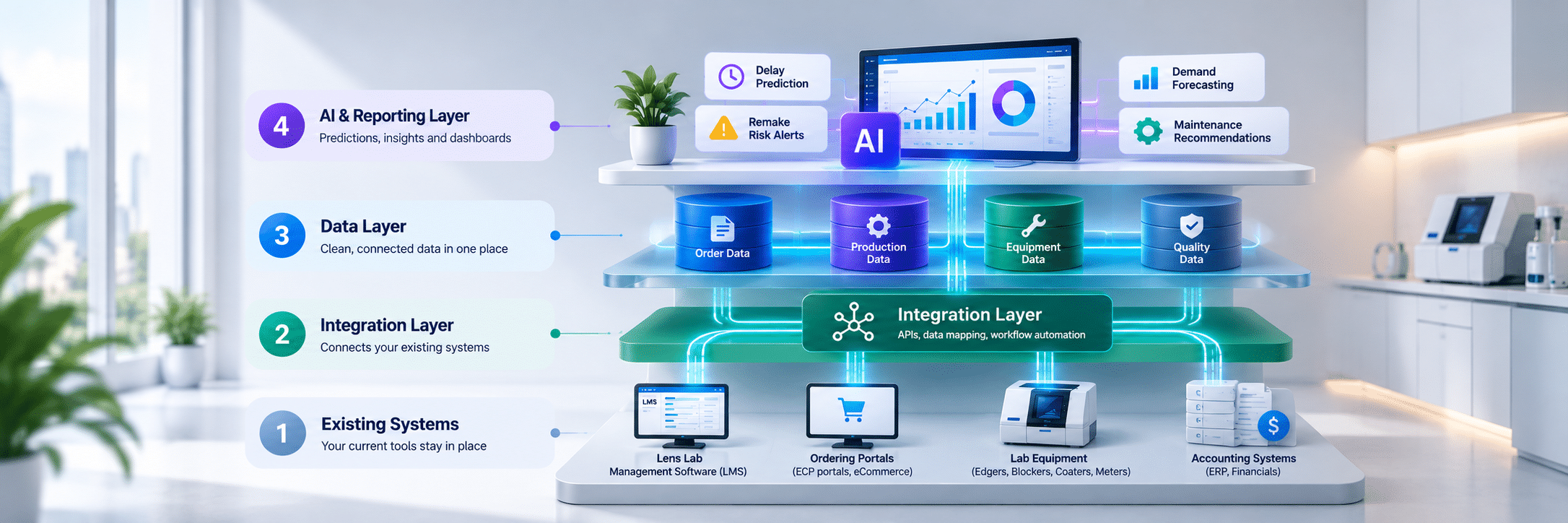
Here is the part of the paradox that is easy to miss. Vertical AI is only as useful as the systems it can see and act on.
In the optical retail example, the answer needed sales, inventory, appointment and patient data. Those rarely live in one place. Connecting them usually involves four layers:
Skip the lower layers and the top layer struggles. Gartner expects more than 40% of agentic AI projects to be cancelled by the end of 2027, citing rising costs, unclear business value and inadequate risk controls. It also warns of “agent washing,” estimating that only about 130 of the thousands of vendors claiming agentic solutions actually offer them (RCR Wireless, reporting Gartner).
Unclear value and weak risk controls are often symptoms of the same gap: the AI cannot reach reliable data, or it cannot act safely in the systems where work happens.
And perhaps the biggest opportunity lies not in replacing every system businesses already use, but in connecting those systems, understanding their data, and making them work together intelligently.
Horizontal SaaS won’t necessarily die, but the winners will need to evolve from tools people operate into platforms that get work done.
What changes for horizontal SaaS
CRM, project management and accounting tools serve every industry. Their likely path is to become the trusted systems of record and action that agents depend on. That puts more weight on open APIs, clean data models, permissions and reliable write-back than on the user interface.
What changes for vertical SaaS
Vertical SaaS already has the context. The challenge is turning that context into AI that completes work, and connecting to the systems customers use that the product does not own. An optical practice platform, for example, still needs to exchange data with labs, payers, POS and accounting.
Selling outcomes, not access
Some vertical AI companies already price on work delivered. Bessemer partner Sameer Dholakia describes companies “solving a piece of work, and charging per work product.” Bessemer portfolio company EvenUp, for example, charges personal injury lawyers for the demand letters it generates.
The next generation of SaaS won’t just sell access to software. It will sell outcomes, powered by AI and built around the way an industry works.
Outcome pricing has its own requirement, though. Both the vendor and the customer need to trust how the outcome is measured. That is, again, a data problem.
If most answers point to data spread across systems you don’t control, integration is the first piece of your AI roadmap, not an afterthought.
Technovate.One is a technology engineering, integration and AI partner. For more than a decade, we have worked with optical retail chains, OD practices, lens labs, eyewear manufacturers and optical SaaS platforms. We don’t sell a competing SaaS product. We help SaaS companies and the organizations that use them build the foundations vertical AI needs.
We build the integration layer between your product and the systems your customers already use. Our system integration services cover APIs, vendor interfaces and middleware, as well as re-engineering older architectures so they can expose clean APIs. This helps SaaS platforms connect with external systems, improve data exchange and support more capable AI workflows.
AI agents and workflow automation
We design AI agents and automated workflows that sit inside or alongside your product, with approval steps and audit logging built in. See our AI agents and workflow automation work.
Data foundations
We build the pipelines, shared data models and reporting layers that give AI one consistent view of the business, through our data engineering and analytics practice.
For operators
For multi-location optical groups and other operators, we connect existing systems rather than replace them, and recommend replacement only when there is a clear business reason. Our optical industry solutions page shows the wider picture.
Vertical AI is AI built for a specific industry. It combines models with domain knowledge, industry data and workflow rules so it can complete tasks that generic tools handle poorly.
Not wholesale. AI is more likely to replace software that mainly stores data or displays dashboards. Software that owns important workflows, encodes industry rules and connects to other systems is better placed to absorb AI than to be replaced by it.
Vertical SaaS gives an industry a place to record and manage its work. Vertical AI uses that context to analyze, recommend and carry out parts of the work. Many vertical SaaS companies are now adding AI to become both.
They usually lack domain rules, business context and secure access to the systems that hold the data. Without those, they can describe a problem but rarely act on it correctly.
Usually not. In most cases, the existing systems stay in place and an integration and data layer connects them. Replacement makes sense only when a system cannot record or share the data the AI needs.
Start with one high-value piece of work customers do around your product. Map the data it needs, connect the systems that hold it, run the AI with human review, and measure the result before expanding.
AI was supposed to kill SaaS. Instead, it is exposing the difference between software that holds information and software that understands an industry well enough to act on it. Vertical AI is booming because it sits on the right side of that line.
The question for SaaS founders is no longer just “Where can we add AI?” It’s “What valuable work can we take off our customers’ hands?”
Building AI into a vertical SaaS product, or connecting the systems your customers already use? Start by mapping where the data behind that work lives today. Talk to Technovate.One about an integration and AI readiness assessment.